
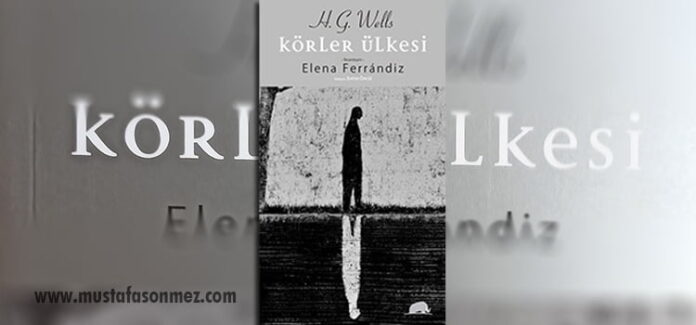
The Country of the Blind is a short story by H.G. Wells. I had read the book years ago. The first Wells book I read was The Time Machine. Once upon a time, I was a devotee of the subject of time travel. Do human passions change over time? My inquiries about reality also turned into a passion over time. The Country of the Blind also questions reality. It was a book I read for this reason.
A poem would go well here now…
Ah, time, how quickly you pass,
or is it us who are passing away?
Leaving the truths behind, through the lies we believe in…
Let’s go back to the book, shall we? Our subject is The Country of the Blind…
Are the things we are attached to as reality, our perceptions, actually a single and indisputable reality? Is life consisted only of our thoughts? Are we perhaps superior to someone else within the reality we are in? Could superiority be a delusion just like reality? What is reality? Is it a delusion? For details on this matter:
In the story set in a strange country where the blind live, the man with one eye becomes king. Does such a country actually exist on the face of the earth? For me, the answer to this question is yes. Because we all can become “blind” to life and truths when the time comes.
🍭 Curator’s Note: More personal reflections

Summary and Subject of The Country of the Blind
The Country of the Blind is the name of a story by Herbert George (H.G.) Wells. In the story, a country is mentioned that is isolated from the world and whose location is unknown. One day, the young mountaineer Nunez reaches this country by following a path he finds in a deep valley where he fell during a mountain climb. The people in the country of the blind are tremendously hardworking, productive, and healthy people. But they define the world behind the rocks limiting their villages as a void, a nothingness.
Mountaineer Nunez wants to explain seeing to these people who live in dark windowless houses, who work at night and sleep during the day. Colors, the sunset, the blue sky… But they maintain that there is no such thing as blindness. This is a ridiculous word invented by Nunez. Nunez is a useless person. He is a freak of nature who doesn’t even know how to walk. Although Nunez thinks he is superior to them because he sees, their senses and perceptions are so developed that Nunez cannot keep up with them.
The healer attributes Nunez’s illness to his eyes being too bulging and his eyelids opening and closing; if his eyes are removed by surgery, Nunez will be a normal person… Nunez accepts defeat. He prefers to escape rather than become blind. Escaping will not be easy at all. Nunez could not become king…
What The Country of the Blind Tells, Analysis, and What is Reality?
The more we believe in and attach ourselves to our own reality; if we accept it as the only truth, then we start to think that life consists only of our own life. What is reality or the truth? Do we have the right to falsify the lives we cannot understand? Reality is only a perception and a delusion…
Something that seems meaningless to us might be very meaningful to someone else… Actually, everything is about making sense of life… Isn’t the main cause of all the chaos in the world the attack on the lifestyle and belief of another, without understanding each other? What are the subjects we discuss the most? Especially the discussions on religion, belief, and sexual orientation are exactly our “Country of the Blind.” For example, LGBT discussions are so ridiculous! Its only aim does not go beyond dividing the society and making people enemies of each other. However, the phenomenon we call reality and truth is completely open to discussion. These discussions are the problems of the old world, undeveloped countries, and societies. There must be those who overcome these problems and know what reality means.
Mountaineer Nunez talks about the sun, the sunrise. The beauty of the world he sees is actually called an illness in that country. One person’s beautiful world is a demonic plague for another. If we, like that country isolated from the world, isolate our thoughts and see them as superior to everything, we will keep floundering in never-ending discussions. Which country in the world have religious discussions, ethnic identity discussions, LGBT discussions raised to the top of civilization? The answer: none of them. When we leave social fights behind and understand the subjectivity of reality, everyone lives in their own world.
This is what I understood from The Country of the Blind. What we call truth is sometimes impressions. We do not see the objects, but only the bundles of sensations (impressions) coming from them. We derive meaning from impressions, connect them to each other, and produce causes and effects. What we call reality is not fixed, but only the product of our habits. Hume would most likely think this way. Kant would say that reality only forms in our mind, and the reality that connects us with the outer world is the product of reason…
According to him, we see the outer world through filters. In short, philosophy and science are still discussing what reality is. What do we do? We immediately claim that the absolute truth is our belief or lifestyle, which is our observation. Gouging out Nunez’s eye was the only solution. Destroying his reality was not the only solution, it was just “cruelty.” Nunez also thought himself superior because he saw. His ego had peaked because he looked at a colorful, bright world. But the blind were tough nuts to crack.
H.G. Wells, as a writer among the fathers of science fiction, touched upon this detail in a very short story. There are as many realities as there are people in the world. We humans create chaos on earth by criticizing these realities and different lives and by accepting our own philosophy of life and belief as the only truth.
What is there beyond the violet and red light frequencies (spectrum) where we perceive life as light and colors, and shapes? Life passes into another visual reality outside of visible light. Color-blind people perceive life and the environment in a different reality. Those red sunsets we wait for with excitement are like a gray and colorless oil painting for color-blind people. Oliver Sacks, in his book The Island of the Colorblind, talks about the perception of reality and the descriptions of nature by an island people who cannot see colors. It is a magnificent book. Again, in the novel Flatland, there is a very strict critique just like in this story. Social criticism and reality are made there through dimensions.
In quantum dimensions, we cannot find any reality among uncertainties. Reality is constantly divided and fragmented. In the famous Schrödinger’s Cat theory, realities are superimposed. The cat is both dead and alive at the same time. The observer determines the result. We can also exist with all human conditions in life with all reality at the same time. Reality should not consist only of our indisputable truths that we blindly convince ourselves of.
Filters, reality, impressions… If Kant and Hume are involved, chaos arises here too. I hope one day I will learn reality thoroughly in a philosophical sense and write about it.
The Country of the Blind Book Information
Nuñez, who falls into a society that has no eyes but has its own order, culture, and value system, is drawn into a tragic conflict because he thinks the ability to see is a superiority. The book, in which Wells discusses the limits of the perception-reality relationship with a magnificent allegory, is 40 pages. This masterpiece, which we can also call a dystopia, was first published in 1904. If you ask where to read the book, whose original name is The Country of the Blind, you can look here.
Long Story Characters and Descriptions
- Nuñez: Mountaineer, falls into the Country of the Blind by accident. As a seeing person, he thinks himself “superior.” He thinks that seeing is a “superiority.” He will realize these wrong assumptions sooner or later.
- Medina-saroté: Young woman in the Country of the Blind. She feels an emotional closeness towards Nuñez; despite the strict rules of society, she symbolizes understanding and peace as an understanding and soft voice.
- Yaluma: An old and respected figure of the Country of the Blind. He represents the beliefs, order, and traditions of the society. He also represents the indisputable strict realities a bit. Someone who is as deeply immersed in his own reality as Nunez.
- Pedro and Correa: People who oppose Nuñez’s ideas, who believe he is abnormal as a “seer,” and who maintain the status quo. These two are perhaps obtaining benefits by bending reality as they wish.