
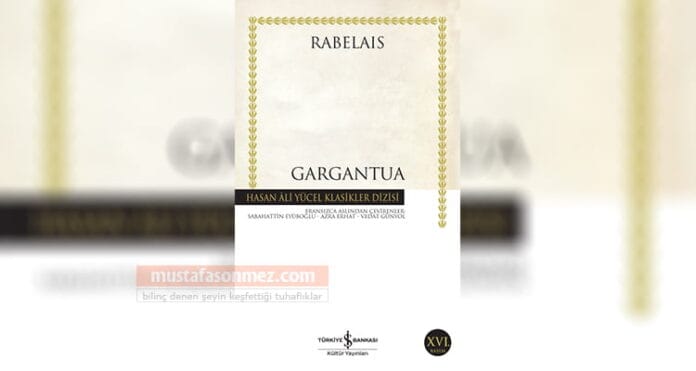
What is Gargantua? There are actually two answers to the question: the first and most real one is that it is the book by François Rabelais. The massive black hole in the movie Interstellar bends space-time with its colossal mass. It opens shortcuts in space-time. However, this work, which inspired the name of the huge black hole in Interstellar, was written 500 years ago by someone named François Rabelais. There is a giant here too. The “giant” in the book is so gluttonous that he would swallow even Interstellar‘s black hole.
Below, I will write a few things in the paragraphs of the book’s plot, summary, and review. In an era where artificial intelligence scans the entire internet and monopolizes knowledge, these posts are also unnecessary. After all, you no longer ask Google, but AI, “What is Gargantua?” or “What is the plot of Gargantua?”. Who searches from websites anyway! If you happened to come across this post, kudos to you!
Just as every book opens the door to a different world for humans, this is one of those books.
✅ Curator’s Suggestion: Discover a new book to read
Gargantua Book Plot, Summary, and Review
The preface of the book begins: “Think of those skyscrapers called cathedrals, crafted by the hands of a jeweler down to their smallest stone; you will call them crystal palaces stacked up for God, yes, but man always creates great works for the sake of an existence that transcends himself, and the only being that speaks by reaching immortality is again himself, man. The Middle Ages is one of the eras when humanity believed in man the most; historians are unfair to see it as dark. Especially regarding language and literature, a more brilliant period than the Middle Ages cannot be imagined.”
Gargantua’s birth is also interesting. After staying in his mother’s womb for 11 months, he is born crying out “drink, drink!”. Since he is colossal, he consumes all resources on his own. Everything is told, from naming him to dressing him and the color of his clothes.
Gargantua is not an ordinary giant’s tale. Especially the clergy are ruthlessly criticized. It contains a splendid satire with an explicit style, plenty of obscene expressions, and swear words. People fighting over foolish things, greedy rulers devouring people’s money and rights… The foolish public getting agitated.
In short, while the order of the Middle Ages is subtly criticized, the book actually makes the reader laugh. Some parts are truly very funny. Especially sentences containing words like shit, bunghole, balls, to shit, and wiping the arse must have caused the author to be excommunicated in the age it was written. The book was found immoral and perverted. Aren’t we considered “immoral” nowadays too when we criticize politicians anyway?
Even though 500 years have passed, there are still countries today that remain unchanged. Exploitations of faith, political immoralities… If Rabelais were to travel through time and come to our day, he would probably have no difficulty and would say: “fucking hell, nothing has changed”. Anyway, there is no need to kick the “balls” of politics here, let’s not swim in deep waters.
Who is François Rabelais and the Giant Tales
Before starting the book, the author says on the first page:
“Good friends, my readers, who meditate this book, Lay aside all predilections, And, reading, be not aversed or shocked; There is no evil or mischief in it. True, you will find no great perfection here, Except in matter of laughing; My heart cannot go another path. Seeing you consumed by sorrows, A laughing book is better than a crying one, For to laugh is proper to man.”
François Rabelais wrote Gargantua inspired by previous giant tales. In addition, the war and characters in the book consist of people he knew, especially his father. Rabelais, as one of the most important intellectuals and writers at the entrance to the Age of Enlightenment, suffered the wrath of the church. Actually, he started priesthood school at the age of 16 and became a priest. He learned Latin and Greek. He escaped staying in the monastery through his well-connected acquaintances.
As a priest living among the public, he left everything behind and studied medicine. He wrote three more books like Gargantua. When his books were banned and his days of exile began, he was finally caught. One year after being captured, he died due to a backbone fracture. As one of the most important writers representing the enlightenment before the Renaissance, he too could not escape the hands of the church and the inquisition.
What is Gargantua? Or Who is He?
Gargantua means giant. It is the name of the protagonist of the novel. He is born as a giant and progresses towards becoming an important person. He participates in wars, establishes friendships with the king’s men, priests, and clergymen. The massive black hole in the 2014 movie Interstellar, directed by Christopher Nolan, also takes its name from this book.
Book Information
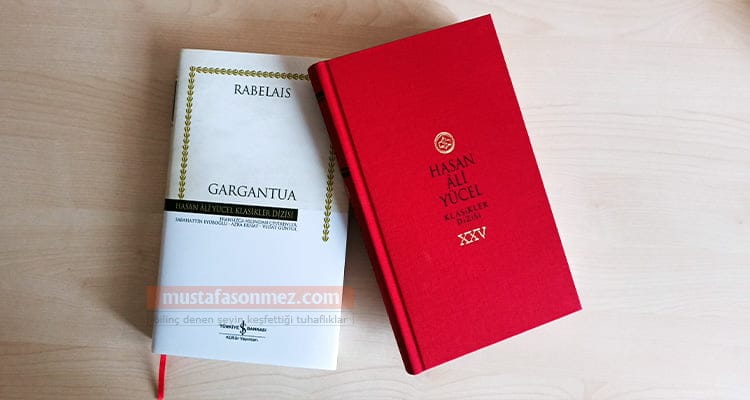
Through the life of the giant Gargantua, Rabelais criticizes medieval education, the church, and authority in a mocking language. While humor, satire, and philosophy intertwine, it exalts the freedom of the human mind. I read the book from the Turkish translation of İş Bankası Kültür Yayınları. I finished the 254 pages in a short time. The book was first published in 1534 and is still valid today because man cannot develop himself.