
Richard Dawkins Books I Read
In this article titled Richard Dawkins Books: Humanity, Evolution, and Belief Across 5 Books I Read, I want to share some of my experiences. Doing readings on the theory of evolution, human existence, human biological evolution, and similar topics can truly be horizon-expanding. Richard Dawkins does not just remain an evolutionary biologist; he also touches upon matters of belief. He is especially known for his debates with “creationists” and the responses he provides.
I must say that new atheism (neo-atheism) is an intellectual movement I never approve of. Dawkins mostly maintains this aggressive attitude as well. But right across from this, “creationists” also display very aggressive attitudes in the same manner. This “language of hate” is a major breaking point for me. No matter what, whichever thought we defend, we should definitely not see it as an attack or a form of superiority.
I also largely think creationists are mistaken. I think existing beliefs, especially religions of Middle Eastern origin, do not reflect realities. I think they do not contain any novelty for humanity or any knowledge that would explain existence. But this does not mean that I should attack or mock believers. I can never accept this.
Richard Dawkins Books and Belief Debates
A conscious reader already knows the philosophical and neurological development of beliefs and religions. The emergence of beliefs was, in a way, a necessity for the human brain; this must be accepted. Because the human brain produces belief. Without beliefs, humanity could not have reached its current position. Religions and beliefs developed, in a way, with the evolution of the human brain.
Right here, we should never make people’s faith, points of refuge, and worship in practical life a subject of debate. Let us debate beliefs and existence in a philosophical sense as much as we want. Let us also debate scientifically, no problem at all. But in the context of theology and personal belief, we should definitely not marginalize any faith. New atheism does the exact opposite of this.
We must build a shared living space, a society where everyone can express themselves without fear and realize their personality and personal existence.
You will say, what does what I wrote have to do with our topic? When Richard Dawkins is read, the topic inevitably diversifies by separating from biology and biological evolution. Psychology enters into this, sociology enters, economy enters, politics enters, philosophy enters… Actually, all of these debates, at the end of the day, form practically a circle around the question “is there a creator?”
But all of these debates, mostly as I said above, continue with fights and inextricable disputes. There will never be a winner of these debates. Everyone, in the reality they experience, will develop a lifestyle, a belief according to their own orientations. And there is no meaning in debating these personal beliefs either.
More precisely, there is no point in debating religion and beliefs within life; it will be of no practical benefit to us. In my opinion, we should leave aside our problems regarding belief in our lives and focus only on living.
Especially politics and personal political ambitions always marginalize people over beliefs. If we look at societies where debates on belief are experienced very intensely, they are in complete chaos economically, politically, and socially. Because they deviate from the real purpose of the state and society.
These are not our topic; they are matters related more to philosophy, perhaps political philosophy. That is why we will not get into them at all.
Why Did I Write So Much About Richard Dawkins Books?
Why did I write so much under the title I gave as Richard Dawkins Books, right? The reason is this: While reading this kind of books, you have to make the explanations above as well.
More precisely, you know that very famous dialectic, which usually has a formula like thesis + antithesis = synthesis when you read Hegel’s philosophy (Hegel does not have such a direct definition either). In his process philosophy, the process consisting of thesis and antithesis develops itself anew with synthesis, and the process continues like this, encompassing the previous one and renewing itself. Knowledge, humanity, and beliefs must also constantly develop and mature by changing; otherwise, there will be no progress.
While reading and learning, perhaps even while believing, it is necessary to progress without “worshiping” fixed knowledge or an ideology. Here I chose the expression “worship”. It is a very harsh expression, but completely in place. One should not approach any belief, any lifestyle—I don’t know how to put it anymore—with a fanatical approach. Because everything one day, I am speaking in terms of knowledge, can be falsified. I mostly ignore Dawkins’ aggressive attitude.
But there is a reality here. You know, as I said above about the relationship between politics and belief; if I write something brief here and move on to the books, Dawkins also says this in his book where he criticizes beliefs. For instance, suppose laws protecting the sanctity of beliefs have been enacted in a country. You can insult an atheist individual as much as you want, just like a homosexual individual. You can curse an unbeliever as much as you want; these are almost not considered crimes in that country’s laws. Because opposing thoughts, beliefs, and other lifestyles are labeled as “unbelieving” or “deviant”. On the other side, a believer will want to hold someone accountable for the slightest criticism directed at their faith. Because the state, statute, and law take sides.
As I said at the beginning, here the state and laws must treat everyone equally. We must not envision such a country, such a society where the ultimate goal is not social peace; no one should be superior to another. In an order where the ideologies and lifestyles of those holding political power are imposed on the public, neither society nor the state remains. The construct of the state must bring an order where everyone can exist equally.
We will achieve this, or it will be achieved, largely through education, by understanding different lifestyles and manners of living. Everyone’s belief is true according to themselves; when the time comes, this can also be discussed philosophically, there is no problem in that. But the state and politics taking sides with the view close to them and seeing others as the other—right here the problem begins.
This situation then descends to society, and society now marginalizes each other. As a result, everyone points fingers at one another.
For this reason, everyone should live in peace in their own internal realm, in their own world, with their own belief, with their own conviction, without experiencing problems with another, without seeing others’ lives as a threat to themselves. There is definitely no need for such debates on belief and lifestyles. Let all debates be on the plane of science and philosophy.
✅📚 My curator recommendation: Few but concise books worth reading
Richard Dawkins Books: Humanity, Evolution, and Belief Across 5 Books I Read
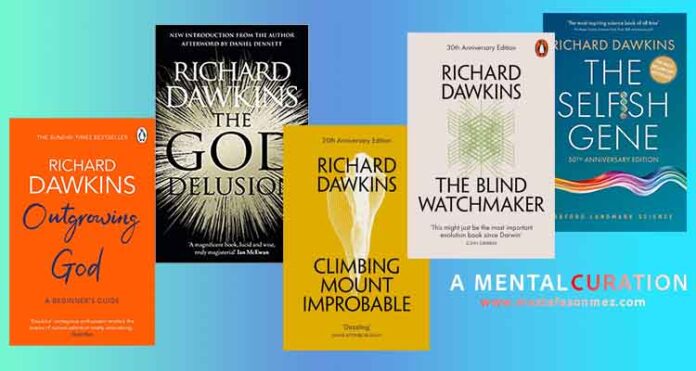
Now let’s move on to the Dawkins books. These are the books I read. I would have liked to read more, but I kept it limited to 5 books. And I wanted to share this experience of mine. Life is a heap of perceptions and experiences. These books are also works that I have read and reflected upon. I present the books according to my reading order. Here are the Richard Dawkins Books I read:
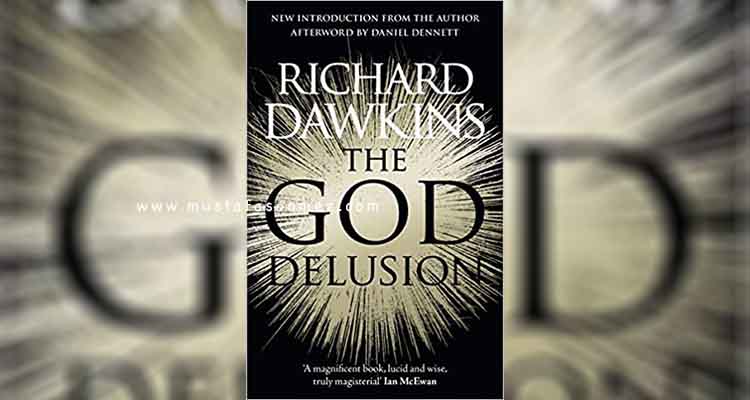
The God Delusion
Richard Dawkins’s book titled “The God Delusion”, while defending atheism, offers a critical look at religions. Dawkins questions the belief in God from scientific, philosophical, and ethical perspectives. He questions the role of religions in human societies, the origin and nature of the universe, and the validity of supernatural explanations of religion. In my opinion, a successful book. When Richard Dawkins Books are mentioned, perhaps one of the best-known: The God Delusion
The God Delusion Book Plot, Summary, and My Commentary
Dawkins discusses how religions affect people and their impacts on society. The book looks from the perspective of evolutionary psychology. It answers questions such as how religion was born, and whether morality is independent of religion. There are dozens of reference sources in the book as well.
Although religions are criticized in the book, almost all of the criticisms are on Christianity. Dawkins makes criticisms of the Old Testament and the New Testament through the Catholic Church and other Christian denominations. Dawkins discusses at length the fallacies of topics such as the ontological argument and Thomas Aquinas’s proofs. Some sections can truly be long. I must say that from time to time I put the book down and took a break from reading. It was the first Dawkins book I read.
The book explains that on the subject of Religion and morality, Morality can exist without religion. Under the heading of Religion and society, Dawkins explains with examples how religion limits individual freedoms and contributes to social conflicts. He gives examples similar to the ones I gave above, which in my opinion is the most solid criticism in the book.
The book is a work described by many as bold and provocative. Some think that Dawkins reduces religious beliefs to simplicity and ignores the complexity of spiritual experiences. In my opinion too, he is a very aggressive person. Also, the lack of empathy with individuals who have religious beliefs may cause the book to be found repulsive by some readers. But as I wrote above, both believers and non-believers always approach each other “hostilely”.
I read the 488-page book and finished it by filtering it through my own sieve, leaving aside the fights and nonsensical criticisms inside. In my opinion, among the books that must be read.
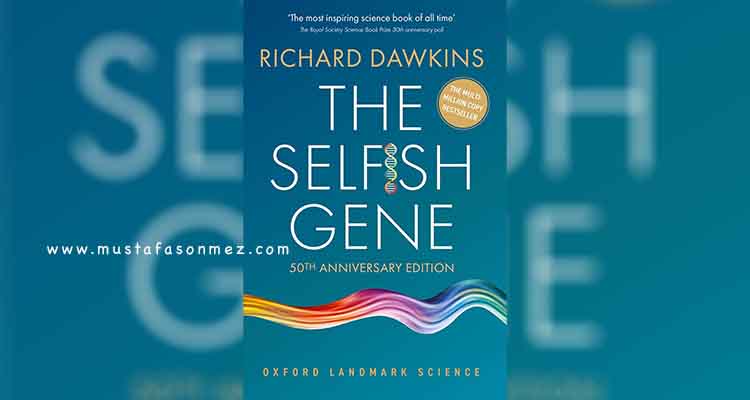
The Selfish Gene
The Selfish Gene is the book written by Richard Dawkins in 1976. The Selfish Gene is a work themed around evolutionary biology. While the book explains the importance of genes in human evolution, it actually explains the struggle genes wage for their own benefit and to carry themselves to the next generation.
Dawkins’s book made quite a splash when it was first published. Dawkins, looking at the purpose of human evolution or human existence from the perspective of genes, refers to humans as “survival machines”. Genes use this survival machine, that is, humans, to copy themselves. This definition can truly feel heavy to most people. Because humans position themselves in a very superior place in the universe. For humans with sacred purposes, being a “survival machine” must be unacceptable.
The Selfish Gene, Richard Dawkins Book Plot, Summary, and My Commentary
The 11th chapter of the book is dedicated to the concept of “meme”. This concept is truly a very important discovery. Dawkins explains the cultural evolution of humans with the concept of “meme”. Cultural transmission is handled not only in humans; it also examines animals. Especially how religion emerged in the meme pool is among the topics discussed in the book.
In its first chapter, the book questions why humans exist. In the second chapter, how life began on earth is discussed with the introduction “in the beginning was simplicity”. The existence of humans and other living beings, and the unconscious struggle they wage to carry their existence to the next generations in the gene pool is explained.
With natural selection and mutations taking the lead, the purpose of life is seen as genes reproducing themselves by using the human body. Maybe this was a very short plot summary, but I think it is sufficient. My goal is to share my experience. Although it is easy to read, The Selfish Gene is a book that provides dense information for the reader. For this reason, it is useful to read by taking notes and reviewing. For those who have biology knowledge beyond popular science, reading the book will be easier. There is no need to understand every chapter of the book. I always skip the chapters I am not interested in. It truly holds a unique place among Richard Dawkins Boks: The Selfish Gene.
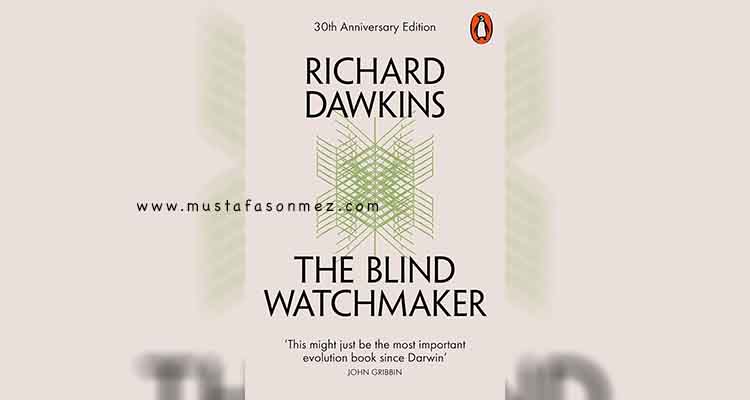
The Blind Watchmaker
The Blind Watchmaker was written in 1986. The name of the book comes from the watch example in the book of the 18th-century theologian named William Paley. Dawkins tries to prove that the old theologian, who defended the idea that the complex mechanism of the watch requires a designer, was mistaken, and in my opinion, he succeeds too.
The Blind Watchmaker, Richard Dawkins Book Summary, Plot, and My Commentary
In the book, Dawkins explains the connection between improbability and complexity. The author actually argues that the complexity that seems impossible and complex biological structures thought to be condemned to a creator in the style of an engineer were formed by natural selection. He explains in detail with an evolutionary perspective in the most plausible manner. The plot of the book is briefly in this form.
Dawkins says in his book that natural selection is the blind watchmaker. He argues that natural selection cannot see ahead, cannot make a plan by considering the consequences, and again has no visible and known purpose. The results of natural selection seem to have emerged after tremendous planning, like a design made by a master watchmaker. The purpose of the book, on the other hand, is to eliminate these contradictions and to prove that everything actually formed as a result of millions of years of steps of mutations and natural selection.
Dawkins repeatedly says this in his book and other books: mutations are random, but natural selection is not random; it works entirely to select what is most perfect. Of course, in the first chapters of the book, he explains at length the perfection and construction quality of the eye and the sonar system of bats. As the author says in other books, he says here too: a poorly seeing eye is better than a non-seeing eye, a half-working bat sonar system is much better than a non-working system. Generally, he explains the operation of natural selection this way. Instead of not existing at all: for instance, instead of the eye being completely blind, he says that an eye seeing poorly and perceiving light is much better, and with natural selection, these vision stages increase layer upon layer and reach the most perfect.
If living beings were designed so perfectly that they could not exist by chance, then how did they come to be? The answer is that entities formed at a simplicity that could exist randomly at the beginning form increasingly complex structures under the influence of natural selection. The structure at the end of the process will seem quite complex to us, and it will be out of our hands to think that this structure definitely cannot be by chance. Dawkins explains natural selection and random existence at length over this thought. Evolution and cumulative selection have no intent, purpose, or goal.
Evolution of the Eye
In the book, it is emphasized that organs like the eye would not be able to function fully in the process if they did not exist all at once. He brings quite convincing and solid evidence against the thesis that gradual or cumulative evolution, and evolutionary theory in general, is invalid. Not only the eye, but how wings, fins, and lungs evolved gradually in fine detail in not only humans, but also fish, birds, and other insects is explained in the book.
Many narratives in the book are found in Richard Dawkins’s earlier or later books; if you have read the author’s other books, what is told can also be evaluated as a slightly more detailed version of the topics in his other books or being retold with a different perspective.
The fifth chapter is on genetics. DNA and its structure, human cells, life or biology in general, human organs, and how humans came into being from scratch are explained in this chapter mostly through heredity. Since the information here is quite understandable and at a basic level, it can be said to be one of the fastest-read chapters.
Origin of Life: How Did Evolution Begin?
What is at the origin of life? Does evolution have enough time to create living things entirely by chance? What was there before the beginning of time and before the formation of life? Did a divine power initiate everything, and is the age of the universe sufficient for life to begin by coincidence? Or does a coincidence really lie beneath everything? These questions are discussed at length in the book. There are more than 100 billion planets in the universe; what is the probability of life forming on these planets? Did life begin only once and on Earth?
There are also chapters related to human biology; especially topics such as DNA and RNA structures, protein synthesis, and how biological chemical structures duplicate and replicate themselves are explained. What was there in the beginning? And also the answer to the question of what was there before the beginning is explained at length in the book. In the beginning, was life composed of carbon-based organic molecules, or according to another view, does it have a structure based on silicon-based inorganic crystals that later resulted in organic processors and then the formation of DNA?
What Was There in the Beginning?
At the beginning of evolution, could inorganic components in the primordial soup have helped DNA pairings and other processes? Could the primordial soup have been prepared from inorganic components and especially with the help of minerals like clay? What started evolution? Along with the questions of how the first replicators worked, probability calculations of the beginning of life are made with the chance factor. The answer to the question of whether life in the universe began only on Earth is also sought.
What is the fundamental idea or main thought of the Blind Watchmaker book? On page 179 of the book, the author summarizes the main thought of the 362-page book in a few lines by saying: “The basic idea of The Blind Watchmaker is that we don’t need to postulate a designer in order to understand life, or anything else in the universe.” That self-operating microorganisms in the beginning would not be from organic components is explained at length in theory. Today, quite a lot of importance is given to this theory. In my opinion, the other important narrative in the book is here. Among the Richard Dawkins books, again one of those I read and liked. Even though it was difficult to understand at times, it was a good experience.
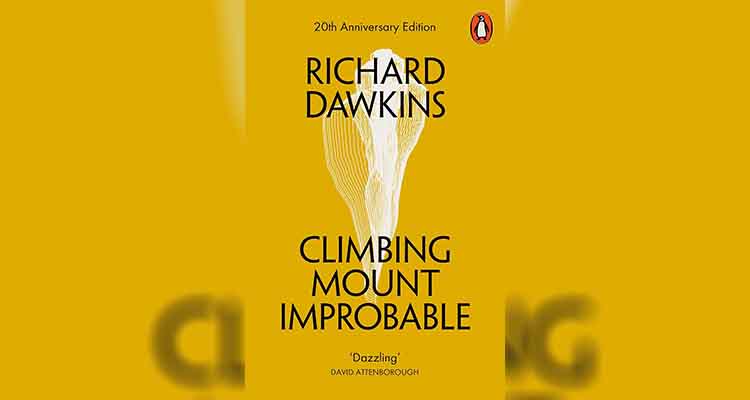
Climbing Mount Improbable
Climbing Mount Improbable is a Richard Dawkins book written in 1996. In the book, Dawkins criticizes creationists for assuming that everything came into existence all at once by leaping to the summit of the mountain from the steep slopes of Mount Improbable. On the other side of the mountain, Dawkins explains the evolution and existence of humanity slowly, over time, among suitable plains, gentle hills, and valleys.
Climbing Mount Improbable Plot and My Commentary
In his book, Dawkins explains how biological structures that do not seem probable, especially by creationists, are actually probable. In the book, a lot of space is reserved for the formation of the eye. While Dawkins explains how the eye evolved step by step, he also gives the answer to the question of whether the first living beings were blind, how they maintained their lives, and how complex structures came into existence.
Touching upon topics of chance or irreducible complexity, Richard Dawkins also explains in his book how natural selection formed a structure like wings. How was the first wing formed and how did its development progress step by step? All of these narratives occurred either by leaping to the summit of the mountain all at once (the summit symbolizes creation or existence) or within millions of years through natural selection.
In the book, it is emphasized that evolution and natural selection are not chance. Mutations and natural selection form the most complex structures step by step. Evolution is not a randomly operating work of entirely blind fate. Natural selection brings everything into existence in the way it should be.
Even if mutations are random, natural selection and adaptation processes bring every detail into existence over a long time. Nothing comes into existence all at once and by chance. Again, whether symmetry and order in living beings are the work of the creator or evolution is discussed at length in the book.
Although the book is convincing, long and detailed narratives can sometimes be the kind that bores the reader very much. For the reader who wants short and clear information, the book can be boring and take a long time to finish. Overall, I can say that it is a book that will strengthen the fight between creation and evolution in favor of natural selection. What Dawkins tells and his science are very convincing.
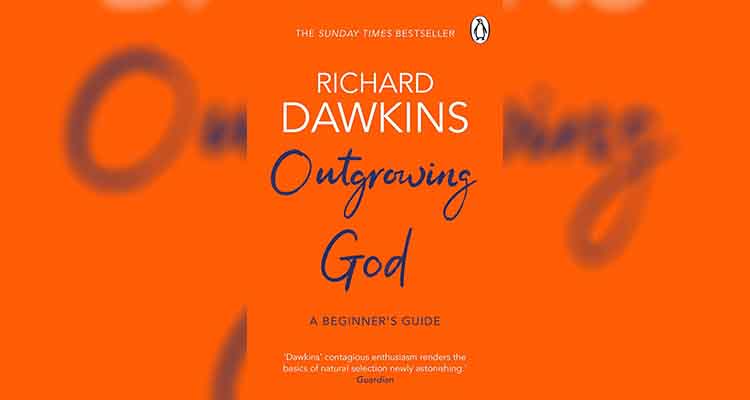
Outgrowing God: A Beginner’s Guide
Outgrowing God: A Beginner’s Guide is Dawkins’s book published in 2019. The book questions the existence of a creator just like in the work The God Delusion. The book consists of two parts. In the first part, the criticism of religions, especially Christianity, whether the existence of God is necessary in philosophical topics such as morality and truth, and the dilemmas of religions are discussed. This book is also addressed to some of my thoughts in the introduction that I wrote at great length. Belief issues are truly very sensitive, but they need to be talked about as well.
In the second part of Outgrowing God, there is the subject of evolution. Belief in God is handled from a more scientific side. While topics of evolution and natural selection are explained, questions such as do we need a god or is a god necessary to exist are answered. In my opinion, the book is worth reading even for these questions. The book progresses with scientific and philosophical topics rather than biology and evolution topics.
Outgrowing God: A Beginner’s Guide Book Plot
In the first part of the book, an introduction is made with mythology. It explains that Greek, Roman, Egyptian, Norse, Hindu, Persian mythologies, Canaanite mythologies, and all other mythologies were once polytheistic religious beliefs. He mentions that people believed in mythological characters such as Zeus and Odin as the god, creator, and owner of the universe and everything. Actually, these are familiar popular science topics. Then, the transformation from mythology and the polytheistic tradition towards monotheism is explained. Dawkins also gives reference books in between.
At the beginning of the book, Dawkins says that just as he does not believe in Zeus, Enlil, Enki, Babylonian gods, African gods, and the tribal gods of Australia, he does not believe in the gods of current existing languages/religions. (In my opinion, this narrative is very powerful.) He says that monotheism is actually a belief system transformed from polytheism in mythologies in different parts of the earth. In the first chapter of the book, belief concepts that almost everyone knows are explained very simply.
In the second chapter, how true our beliefs are and whether someone named Jesus lived in history is discussed. How beliefs, religions, and written texts changed throughout history is also explained well with the Chinese Whispers example. In the second chapter, it is also discussed that Jesus was definitely not the Messiah and that this Messiah concept entered Christianity later. When the Bible was written and how the Gospels emerged is explained in the second chapter. It is mentioned that the sections bearing the names of the apostles were actually not written by the apostles.
In the book, contradictions within the Bible, the killing of Jesus by crucifixion, and again the apostles are mentioned in detail. The author, also touching upon the event of miracles, covers in detail in the book why miracles cannot be real, in line with two possibilities David Hume stated about miracles.
Legends such as the creation from Adam and Eve in the Bible and the forbidden fruit of Paradise are said to be shared with mythologies in various parts of the world; in addition, the common points in Judaism and Egyptian civilization are explained in Chapter 3 of the book. The answer to the question of whether it is easy to invent a myth is also in this chapter.
The book Outgrowing God touches upon the subject of the origin of morality. Can we be good without God? What is the source of goodness? This question is discussed in the book from both philosophical and evolutionary perspectives. I had read this topic in the book The God Delusion as well. This book stands like a repetition of The God Delusion in some places.
The other part of the book is about evolution. Especially, it explains that evolution and natural selection are not by chance, and how natural selection brought complex organisms into existence. (I can say that this narrative is actually a repetition of his other books.)
Whether the crystals and other biological structures in nature that Dawkins explained in his earlier books were really made by an artist, or whether everything existed without God through quite simple rules at the molecular level is also explained. In the second part, he repeats the evolutionary theory and other theories of the idea of God and the idea of believing. Is the idea of God written with a genetic code? What advantages could it have for humans? This topic is also covered. The answer to the question of whether we developed religion and belief as an evolutionary advantage is here as well.
Book Review and My Commentary
The first part of the book is written almost entirely on Christianity. The book’s criticism of Christianity: while both modern Christian understanding and denominations are criticized, on the other hand, the origin of Christianity is also looked at in detail. As for me, I read topics such as the Christian religion and, depending on it, the Old Testament, the New Testament, Judaism, or topics like modern Christian denominations and the church. To be honest, it didn’t really attract my interest. Because we are quite far from the Christian world. But it was still a good section.
The book is easy to read. Especially the last chapter is like a summary of Dawkins’s earlier books. The topics are written in a quite simple and understandable language.