
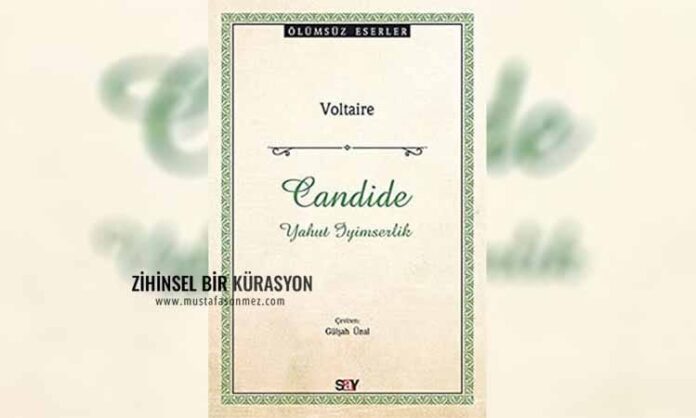
I am here with the plot, summary, and review of Voltaire‘s Candide, or Optimism. (Candide ou l’optimisme) Actually, it is not a pitch-perfect article or review, but rather I want to share a beauty that I have read.
This is the novel written by Voltaire (François Marie Arouet) in 1759. François Marie Arouet wrote the novel under the pseudonym Voltaire. Because of the heavy criticisms in the book, his life would be in danger. The work, which can also be called a philosophical novel examining the topics of optimism and evil, is shown among Voltaire’s masterpieces.
The novel was criticizing Leibniz’s philosophy which defended that there is no evil, that we must affirm everything, and that the existing evils could actually be the best of everything. Evils are actually not bad, they are the best thing that can possibly happen. In fact, God not only creates the best possible world, but what happens to us is also the best of what can be. Evils, on the other hand, are not evils; they are events that enable man to see the best. Everything is the best of all possible options.
Now let’s move on to the details.
✅ Curator’s Suggestion: Discover a new book to read
Candide, or Optimism: Plot and Summary
Alongside a noble family, in a grand castle, he is happy with their tutor, the great philosopher Pangloss. He has never left the castle and spent all his days there. Candide falls in love with the Baron’s 17-year-old daughter, Cunegonde. When he is caught with the girl in an inappropriate manner, he is kicked out of the house by the Baron. How could a mere piece of a servant do such a thing, right?
Candide has adopted the optimistic teaching of his mentor, the philosopher Pangloss: There is never evil in the world. Everything is good, there is no such thing as bad. Embarking on a journey with this teaching, the naive Candide will plunge from adventure to adventure. The ship he boards sinks; only he and a trickster sailor survive. He is enslaved by the Bulgarians, gets beaten with a stick every day, and is saved just as he is about to be executed. None of these are problems for him because everything is good. Even within evils, there is a good.
His mentor has also survived a great massacre. The manor was raided. Everyone died. The war between the Bulgarians and Avars has accelerated. But this is not a problem, everything is good. Candide is drifted from place to place. He participates in wars and is found guilty by the inquisition. He especially mocks the papacy ruling Europe for seeing sins behind earthquakes. People slaughter each other barbarically. Christian priests, just like state rulers, are consumed by the greed for money and status.
The last Aztec community surviving the Spanish invasion gives Candide kilograms of gold, which they call “yellow mud.” Candide learns that his mentor was not burned by the inquisition and goes after his lover. He commits murder. Meanwhile, while being targeted for execution under the assumption of being a Jesuit, his gold is stolen in Holland. But still, he thinks everything is good.
Then, between his old mentor and another man who is the exact opposite of his mentor, his path falls to Istanbul. Here, he encounters a fake sheikh. This fake sheikh and his disciples are impaled. However, a self-contained, wise dervish farming in Istanbul gives Candide and his two mentors a beautiful lesson. He concludes his story by saying, “We must cultivate our garden.”
What I Understood from Candide, or Optimism: Plot, Commentary, and Review
In the novel Candide, or Optimism, Voltaire criticizes and mocks Leibniz’s philosophy within a very simple, fluent love adventure that lacks unnecessary descriptions and romanticism. Pangloss represents Leibniz here. The naive boy Candide, who plunges from adventure to adventure, finally gives up the thought that everything is good. There is also evil in the world. Actually, there is no need to expend much effort to arrive at this conclusion. There is evil in the world; in fact, the moment we abandon goodness, evil automatically comes to light.
Is everything predetermined? Is there a relationship between fate and cause-and-effect? Is a god who punishes people good? Is everything beautiful? Are illnesses and earthquakes a predetermined and hard-to-overcome fate for man, and are they good? Is the world not full of wars, status ambitions, greed for money, and a race of evil? Especially the dialogue with the 6 dethroned kings in Venice is exemplary. Do evils lead man to happiness and good results? These questions do not have a single answer, of course!
By cultivating the garden, meaning just like the farmer dervish did, it is necessary to work instead of dealing with idle matters and worthless thought surpluses. By contributing to life with a correct attitude, by working and producing, we can bring humanity to a better place and say “stop” to evils. Accepting evils by saying “there is a wisdom behind it,” believing it is a written fate, and just waiting like that is the basis of Candide’s story. And when he abandons this attitude, Candide’s world will change. Just as the world is not the world of the best possible options, what happens to us may not be the best of all possible things either. The protagonist of the novel, who is liberated from this perspective, no longer sees evils as the best of what could be.
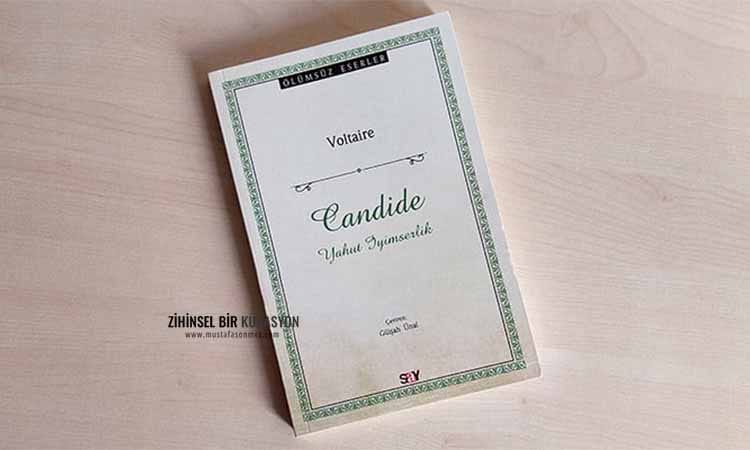
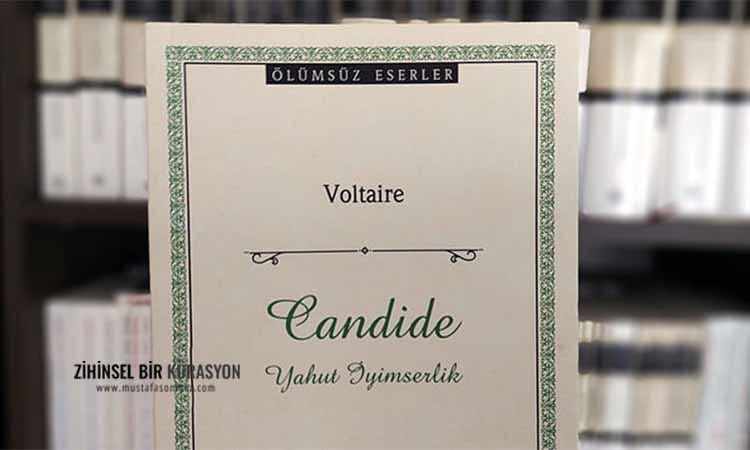
Book Information
👉 Candide is Voltaire’s book that narrates ruthlessly, and sometimes ironically, the question “Is this world the best of all possible worlds?” through the disasters that befall a naive youth. I liked the book very much. In it, optimistic philosophy is shattered into pieces by the critique of war, religion, and power. It is a book to be contemplated upon, and for this reason, I added this masterpiece to my site. It is one of those books that are far from being popular, to be read slowly while pondering. The book is 144 pages and ideal for a weekend read. Read this book instead of useless Netflix series, movies, and popular novels. Say Yayınları is the publisher I read. There are different editions in other publishers under the name “Candide, or Optimism.”