
Dostoevsky Novels I Read and Their Traces in My Memory. For me, Dostoevsky has never been just a fiction writer or a familiar author of classic world literature or Russian Literature. Dostoevsky is above all a philosopher. He explains existence, humans, social problems, and the dark inner world of humans very well.
I am not someone who reads too many novels. Of course, I do not look down on fiction. Fiction, whether it is science fiction or classic novels, it makes no difference, or any institution, this can also be fantastic, meaning whatever comes to our mind, we can include all of it. Writing is one of the most mysterious talents of the human mind. There is also a concept called Dostoevsky syndrome. Again, the imagination ability of writers was more extensive and broader than normal brains.
Normally, when people sleep, they dream. There are no boundaries in dreams. Because the reasoning frontal lobes of the human brain are completely disabled. Since we also close our eyes, the sleep process starting from the brain stem now goes to the visual nerves of the idle visual cortex, and we see the simulations formed in our brain. These simulations have completely been purified from the reality of the mind. That is what being a writer is like: like a state of dreaming while awake.
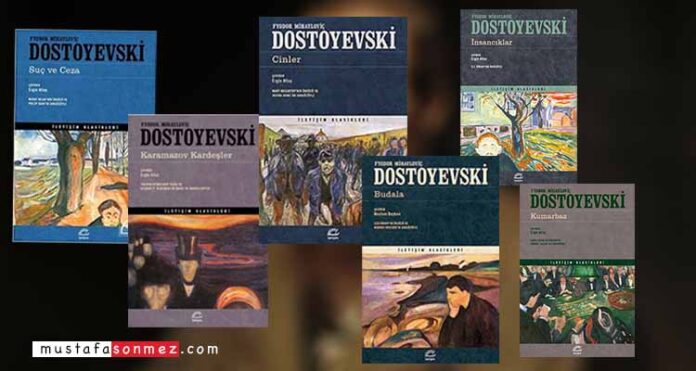
We say friend, he has always been one of my favorite classic novelists. Especially Demons (The Possessed) and The Brothers Karamazov are not just simple novels; they are works containing very deep philosophy within. You know I had said I don’t read too many novels. That is truly so, I am more of a popular science and a bit of a philosophy enthusiast. But without fiction, humans cannot carry their imagination, their mind, their memory into the future. I am absolutely sure of this. You know I had a post named “Science Fiction Classics I Read That Left a Mark in My Memory”, and there too I had said such things more or less.
A thing first appears in a human’s mind, in their imagination, and then the human chases after the imagination, wants to realize it. Science fiction, or I shall call it fiction in general referring to all novels, is the human stepping beyond their own memory as well. Perhaps it is the search for the unseen. Humans perhaps exist only with what they perceive and see. Truly, what actually brings humans into existence is their impressions, their habits. What we call “I” is nothing other than moments and memories accumulating in our memory. The outer world is largely formed in our brain, in our mind. And our mind sometimes wants to step beyond the visible as well, imagines the unreachable reality beyond the visible as well. I do not want to prolong this topic too much; here in my very short article named “Poetry and Cosmos: Writing Means Pushing the Limits of Being Human”, I actually said much more.
📚 My curator recommendation: More books and mental journeys
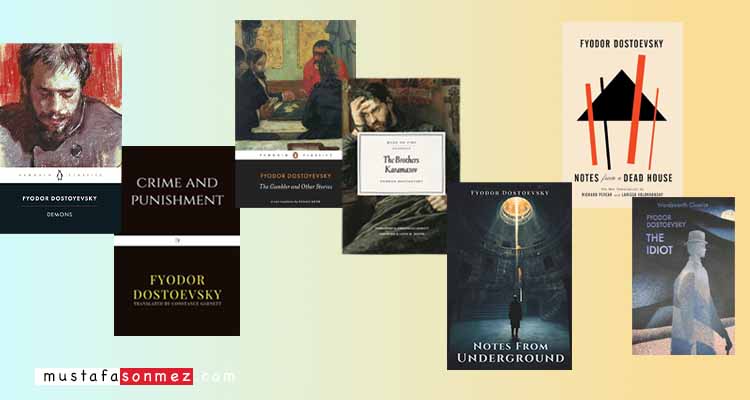
Dostoevsky Novels I Read
Now I want to move on to Dostoevsky novels. I want to take a dive with those wonderful books I read, experienced, which gave me very enjoyable moments, and which I sometimes worked on for days. After all, life is composed of our impressions and experiences. We cannot step beyond our experiences. And do you know what the important thing is: adding beautiful memories to life. Sometimes when you read beautiful things and finish them, the taste of that moment lingers on the palate. So for me too, that pleasure, that state of literary awe when I first read these works still remains in a corner of my mind as on the first day. And I wanted to share this experience of mine. Being human, or remaining human, I guess is exactly this: writing. Besides, my aim here is not to present you with a broad summary or to review the books I read; I only want to write these experiences of mine. Sort of like a digital archive, like a reflection of my mind… The important thing is, as I said above, the experiences and beautiful moments we leave to our life, isn’t it? These books are among them.
These are what remains in my mind. These are the works I consider a part of my mental development. When I first read them years ago, I had said “what is this guy talking about?” But when I read them again years later, I also observed my mental development. All of these are traces of my mental development. I read, watched, wrote, and developed. My belief, my view of life, everything underwent a change over time…
This article is not a Dostoevsky review. It is a personal digital archive, a “mental curation,” telling the traces the novels I read left on me, my thoughts changing over the years, and the place of these books in my mental journey.
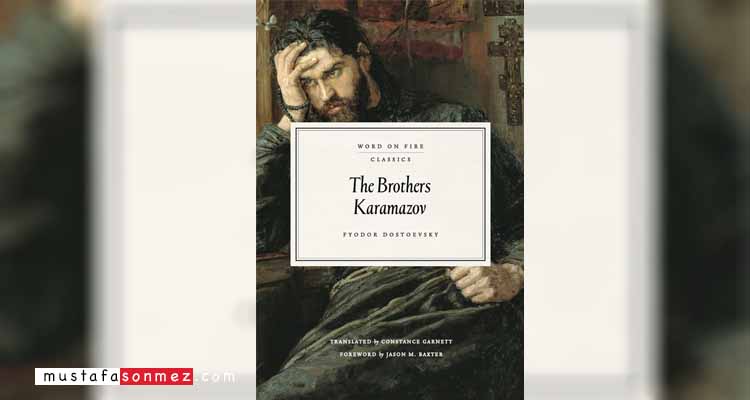
The Brothers Karamazov
The Brothers Karamazov is the last novel of Fyodor Dostoevsky. A massive 1000-page masterpiece he wrote just before dying. For me, the novel is one of the four great sacred books of world classics. When I first read the book years ago (about 10 years), the novel’s dialogues had bored me, I suppose because it could not realize my mental enlightenment. I must confess that since I learned to think more realistically and analytically more or less in the last 10 years, I can say I experienced literary pleasure in my second reading of the novel. As I wrote before, what we call a novel must have a philosophy. There must be thought and criticism inside it. It should examine life and humans. It should push the limits of dreams.
I know I had said The Brothers Karamazov is the last novel Dostoevsky wrote; his first novel is Poor Folk. In this masterpiece, at first glance, there are three brothers and an infamous father. The Karamazovs are known as lustful, dishonest, deceitful, and untrustworthy people. Even though it is an average 1000-page novel, I read the novel as if it were four interconnected novels. I had read the novel years ago but nothing had remained in my mind. When I read it again, I was practically captivated by the philosophical dialogues in the novel on subjects of religion, belief, Christianity, justice, crime, law; humanity, and existence.
It would be wrong to say the plot of the novel is love and patricide. The brothers are Dmitri (Mitya), Ivan, and Alexei, that is, Alyosha. The father is Fyodor Pavlovich Karamazov. Every character actually represents a philosophy, a life. The philosophical debates on religion, belief, morality, faith, and devotion made through Staretz Zosima show us the value of the text. Especially the “Grand Inquisitor” chapter had taken me away from myself. I had bowed respectfully before that narrative and read that chapter repeatedly.
Reading the criticism of life, the animalistic and humanistic sides of humans; beliefs; relations between men and women; family bonds; religion; human existence; and superstitions was enjoyable. Then I realized that from the 19th century to the present day, actually nothing has changed. Finishing the 1038-page The Brothers Karamazov was also difficult.
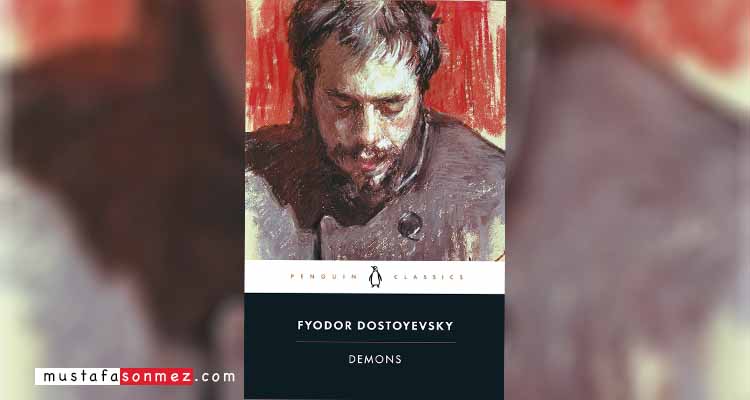
Demons
Even though the name of the book is translated as “Ecinniler” (The Jinns), this expression is actually wrong. “Ecinn” is the plural expression, and a “-ler” suffix has been added to its end as well. Since the novel was first translated in this way, other translations also continued in this manner. It is among the Fyodor Dostoevsky masterpieces translated also as “Cinler” (Demons). Some parts of the book, especially the narratives of belief and moving mountains, reminded me of the long debates in The Brothers Karamazov.
As I will write below, there is a complete character confusion in the book. But as the novel progressed, I realized that it was not such “confusion” at all.. Even though reading it is a bit complex for the first 300 pages, later on I was surprised by the fluency of the book and the progression of the events.
Demons handles Russia’s political turmoils, nihilism, atheism, socialism, and workers’ uprisings. The characters are religious, nihilist, socialist, and atheist people. They secretly bring the leaflets they printed in Europe to Russia. As in other novels of the period, in Demons as well, European countries like France and Germany are important for high society and the Russian bourgeoisie.
The oppressed and impoverished working class, the dismantling of the system of slavery and feudalism, internal turmoils, socialism, and searches for justice are among the topics of the novel. Especially nihilism and atheism are heavily dwelt upon in the novel. The philosophical conversations in the novel are on religion, the universe, the world order, beliefs, and economic systems. Truly, these philosophical conversations make the novel a very valuable and unique text.
To understand the novel’s personas, it is necessary to read at least 300 pages from the novel. Since the pages explaining the relationships and characters of the novel’s personas and kinship relations are very opaque, it is useful to take notes of the personas. I will write the personas here too. The novel starts by explaining the meeting of Stepan Trofimovich and Varvara Petrovna and their living in the same house. Later, the duo’s children and friends are included in the novel. Alongside family relationships, the novel continues with political turmoils and the work they do for the revolution.
I had said the novel initially starts with Varvara Petrovna Stavrogina and Stepan Trofimovich Verkhovensky. In the very beginning, there are narratives on family relations and marriages. The novel mainly focuses on an approaching socialist revolution and five revolutionary friends. Pyotr (Petrusha) Stepanovich Verkhovensky, Nikolai Vsevolodovich Stavrogin, Ivan Shatov, and Alexei Nilych Kirillov print and distribute leaflets for the revolution they believe in. The prison escapee Fedka also joins them.
Very good two-person philosophical conversations take place in the novel. These are very good dialogues on religion, belief, and politics. I felt Dostoevsky’s philosophical power in these dialogues. Among all these debates, a murder is committed. The five revolutionaries strive to identify the traitor among them. As a result of this, Pyotr Stepanovich will kill two of his friends and Fedka as well. I don’t want to draw out a detailed summary of the novel and spoil the surprise for the reader. Be it the mutual conversations within the novel, be it its plot, its storyline, be it in terms of reflecting the spirit of the period, it is a complete masterpiece. It is a literary marvel.
I end with this quote: “Everything, all these murders, everything done for the revolution must actually be the work of demons. How else could these people, who have lost their minds, do so much evil to each other!”
Crime and Punishment
Undoubtedly, it is the magnificent novel of Fyodor Dostoevsky among the giants of world literature. A masterpiece with a narrative that makes one say, this is what writing a novel is like. Perhaps when Dostoevsky is mentioned, this would be the first work we recall and read.
I know I wrote it above, it will fall into repetition, but I feel compelled to repeat: I had a review article named Dostoevsky Syndrome. How do geniuses and writers form this imagination, style of narration; the topics in their minds? Researches have actually revealed that certain regions of these people’s brains show different development. Crime and Punishment is at the summit among world classics. Be it characters, psychological analyses, humans’ ethical feelings, or social inequality, we are debating the same problems even in the 21st century. For this reason, reading world classics repeatedly does not weary one. For me, it was among the best moments that could be experienced while living.
Crime and Punishment is a novel written on the murder committed by the novel’s protagonist Raskolnikov and the reasons for the murder. Society, justice, poverty, and the chasm between social classes are handled very well. When I read the novel again 10 years later, I realized how superficial my first reading was. At that time, the impact the novel left was not as much as my second reading. Raskolnikov sees the pawnbroker woman as a louse. Such people are like lice exploiting and robbing the public. Raskolnikov, in an article he wrote, talks about people who have the freedom to commit crimes and places himself in the class of people who have the freedom to commit crimes. Sometimes a murder can save the lives of thousands of people.
Today, I see this mood and paranoia of Raskolnikov very clearly in politics, in strict beliefs, in areas where we socially marginalize, and in the perspectives of technology and AI companies. Although I passed it off saying ‘this is a fiction’ when I first read the novel, in my subsequent readings I saw that not much has changed from the 19th century to the present day.
Raskolnikov’s Article
Arguing that reason and will are eclipsed while committing a crime, and therefore the criminal is caught in a diseased state, Raskolnikov debates whether the reason for this eclipse of the will is the urge to commit the crime itself, or whether the crime is committed because the will is eclipsed. Was illness the factor engendering the crime, or was the crime producing an illness conforming to its own shape? Raskolnikov thought what he committed was not a crime, but on the contrary, a service to society. At this point, Dostoevsky designed such a character that we can feel this character even today.
One of the most interesting examples in his article was that people like Muhammad and Napoleon were among those who had the right to commit every crime. People had practically rewarded their murders. People had done their best to keep their names alive. These people, called extraordinary, shed blood for society, for laws. But they were never called murderers. Raskolnikov too murdered the pawnbroker woman for such a purpose.
Today as well, do not most people think their belief is the supreme one, look down on another, and try to destroy their living space? Do politicians not deem every kind of evil through rules and laws deserved by those not of their own for the sake of political ideals? Raskolnikov is actually still wandering among us as we progress toward the middle of the 21st century. He does not have an axe in his hand, he has more contemporary methods. Reading this novel truly took my mind on a time travel across centuries and on a journey from the consciousness of a human to the consciousness of other humans.
What forces Raskolnikov to confess is the thoughts of his sister, his lover, and his mother. He must be cleansed of the evil he did. The way to do this is through the teachings of Christianity: to repent and of course to confess his crime. His soul will only be cleansed with the punishment he will suffer. In committing the crime, he justified himself, for the people, for righteousness, he did not think about the aftermath of the murder he committed. Raskolnikov’s murder is to prove his thesis in his article published in the magazine and to test whether he is a louse or someone who has the freedom to commit crimes. If the intended thing is good, murder can be committed.
I extracted this meaning from the novel too: In practice, neither punishment nor belief can save a corrupted consciousness. Because an order where politics is corrupted, where political interests take precedence over the country’s interests; where social justice is disrupted; where the superiors see themselves as justified, produces hundreds, perhaps tens of thousands of Raskolnikovs. I made this comment when I last read the novel too. He had not committed the crime alone, this was certain. Today as well, we are in a world order that leaves humans alone with their economic and personal dead ends. Ranging from school murders to Raskolnikov-like crimes committed against women, children, LGBT individuals, and those of different religions and beliefs, the responsible party must actually be the disconnect between the state and the multiple voices of the public. Because it shouldn’t be too hard to prevent a crime before it is put into action. Education, surveillance, and a balanced politics-public relationship solve most of it. Dozens of similar thoughts passed through my mind while reading Crime and Punishment. It was a very good experience for me. I am glad we have beautiful books in our lives.
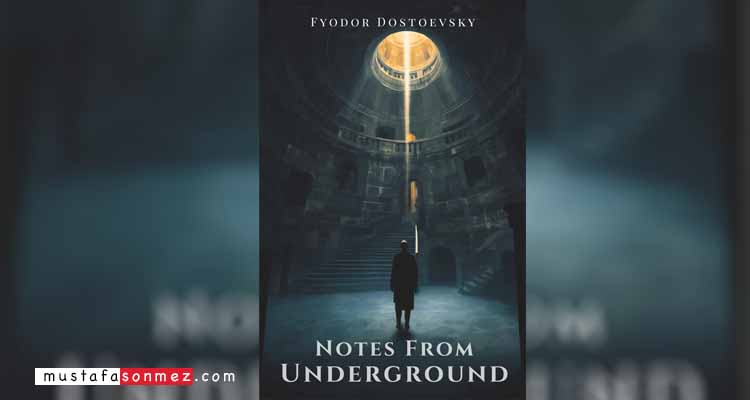
Notes from Underground
Notes from Underground was one of the first books of Fyodor Dostoevsky that I read, and the reason is very simple: it did not have many pages, it was a thin book. But as I read it, it kept drawing me to itself. Especially the “pleasures of being humiliated” in the novel, a person imprisoning themselves in their own consciousness did not really enter my mind in the first reading. Years later, my second reading left a very good trace of the novel in my mind. Especially the first chapter…
While reading the resistance of the novel’s protagonist, who constantly humiliates himself and has isolated himself from life in the novel, the lines “To live longer than forty years is bad manners, is vulgar, immoral” are ideal words for someone isolated from life, having no purpose left other than filling their stomach. But really, what does living less or more signify anyway! The order we set up in the world, the human-centric life, us thinking of ourselves as the master of everything—what does it change! The lines of regret Ahmet Rasim felt (it must be in Gecelerim and Falaka) looking at his children, for causing beings who will suffer like himself to come into the world, also show that life is actually an underground for all of us.
We spend life within management systems that do not treat us as humans and exploit us with the utopian fictions of our beliefs; and when the time comes, we die and become history. When one withdraws from existence, it becomes impossible to speak of something called “those left behind” anymore. While living, one should live worthy of human dignity.
Instead of trying to understand the realities of life, we console ourselves, this is certain. Humans have not even been able to decipher yet what life and the universe exist for, and have not been willing to for thousands of years either. One day the reality of life will come to light, of course. One day the heat death of the universe will occur, it will cool down and turn entirely into a grave as vast as infinity. As for us, we already turn life into a cold grave while alive.
Actually, the 21st-century human is also an underground man. In a world where the economy sinks, where administrators chase political ambition, and where people see each other as “the other,” we become increasingly lonely. Our friends, on the other hand, serve no purpose other than being a dry crowd. Here, I do not aim to summarize the novel. I must only say that we have all become underground men. The world’s humans experience the pleasures of being humiliated. Because in politics, they elect the one who hurts them the most. From being lynched on social media, just to get interaction, we are in a state of feeling pleasure… We are underground. X, Instagram, our digital subscriptions, perhaps even AI itself is our underground.
When I read the novel, these had come to my mind. This is my mental experiences.
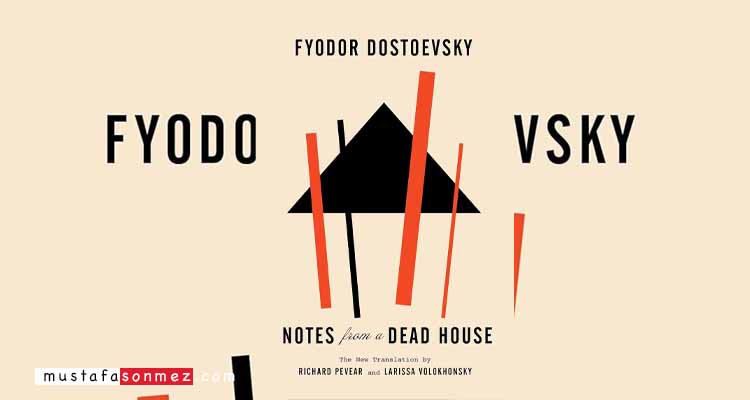
The House of the Dead
The House of the Dead, or under another name Memoirs from the House of the Dead, is among the works of Fyodor Dostoevsky that I read. Among the books I read again anew. I read almost all the Russian classics I read anew. I had read it a very long time ago; to be honest, it cannot be said I understood anything from what I read then. But they were beautiful days, I had just started world classics, wondering which publisher, which translation I should read from, I had read by comparing different translations. It was a beautiful experience. As a human, I need knowledge that will keep my memory bright. Maybe one day with the knowledge in my memory, my consciousness will be wiped away from space-time, but while living, these experiences give humans a distinct dimension of consciousness.
Fyodor Dostoevsky is arrested on the grounds that he had a hand in a plot organized to overthrow the state administration. In 1849, he spends months in prison. Just as he is about to be executed by firing squad together with other plotters, the news arrives that they were pardoned by the Tsar. He has returned from the brink of death; he is only 28 years old. But he is sent to Siberia for hard labor and lives a prison life for a total of 10 years. He spends this sentence in various places. Later on, he begins writing his famous novels. He writes The House of the Dead in 1862. This novel actually tells the author’s prison days. It tells the days he was condemned to hard labor.
The definition and description of the remote town of Siberia, people being friendly and their benevolence are narrated. The Russian justice system is severely criticized. It is mentioned that forced labor and hard labor, especially punishments like branding the foreheads of ranking soldiers, are not humane. Solitary confinement and flogging punishments especially do not reform prisoners; they make them run wilder, and when they get out of prison they commit the same crimes again.
The prison is like a house of the dead. Life is difficult here. Everything is money. Prisoners acting ruthlessly toward each other do every kind of evil. Everything exists, starting primarily with vodka smuggling. The one who pays can even go outside. Noble prisoners are never liked; they are constantly harassed, humiliated, and even beaten. The hospital is a resting place for prisoners. They long to go to the hospital by faking illness. The hospital is actually not a very good place either. Executioners especially are described as despicable creatures. These executioners take all kinds of bribes. They promise to do the execution quickly and swiftly and take tons of money. If they do not receive money, they carry out a painful and slow execution.
I don’t know if it is possible to extract a summary for The House of the Dead. The narrator of the novel finds the notes of a former teacher who served 10 years of hard labor in a remote town in Siberia. The teacher named Alexander Petrovich, whom he occasionally dropped by, dies, and among the leftover bundles of paper, he finds the exile notes he named Scenes from the House of the Dead and shares these notes with the reader.
While reading the novel, this question always came to my mind: what is it that takes a human out of being human? I guess we cannot explain most things with humanity’s genetic predisposition alone. The environment we live in is very important for us too. When a human’s connection with the state involved in political intrigues and, accordingly, with society is cut off, their connection with their own mind is automatically cut off too. I don’t know, this connection suddenly came to my mind; for Hegel, the individual, civil society, the state, and similar institutions and organizations are a whole, you know, for a human to be able to exist within the state. When I think about it like this, if we are truly going to exist, we will exist as a whole. I look at crime a bit like this too. We cannot prevent crime by throwing into prison, by giving heavy punishments to criminals. Very different dynamics lie beneath this. I do not want to drag it out too much; for me, Notes from Underground was not just an autobiography of Dostoevsky; deeper philosophical PROBLEMS lay beneath it, and it was able to establish a connection in our day again. It was a good experience for me. It was among the beautiful books I read in my life.
Other Dostoevsky Books I Experienced
Here I deliberately used the expression “experiencing”. Because I prefer experiencing instead of reading. It is truly so, a human exists only through their experiences. The outer world entirely consists of our experiences and the patterns in our memory. Everyone’s perception of life changes depending on what the codes of that “matrix” they live in demand, perhaps. It reflects to us as reality according to our life orientations. No need to philosophize too much here, of course. This is not my goal either. All books, perhaps whatever I watched and saw, all of them have a trace with a distinct frequency in my memory.
In White Nights, there was Nastenka, who never went out of her house, tied to herself by her grandmother with a safety pin. This was not a simple romance or love story. It was finding oneself, a discovery. The novel character had actually embarked on a great discovery. White Nights holds a very distinct place for me. The plot of the story, the characters are truly very vivid. The Meek One is a very tiny story, but Dostoevsky practically descends into the depths of human psychology. The Meek One summarizes very well husband and wife relationships that do not understand each other, how people easily ruin each other’s lives. The expectations of both sides from each other, the great tension they experience; their psychological dead ends are told very well in the story. It was a short but truly good story.
Poor Folk, its original name is “Poor, Destitute People”. The novel reminded me of that heartbreak, that hope in White Nights. The inadequate salaries, heavy works, and bureaucracy of the officials we read about in Dostoevsky novels appear before us here too. Especially people living in rooms and barely making ends meet face us in this novel as well. On one side there is wealth, on one side poverty. City life is not easy at all for poor people. It is an unbearable place especially for a civil servant working with a low salary. The hardships Varvara endures, being left poor and orphaned with her mother in a village setting, show the reader the face of poverty. Desires, hopes, and heartbreaks… truly like a real fiction of a human’s life… this was a beautiful experience too.
Perception and Consciousness While Finishing Dostoevsky
The Meek One, The Double, The Gambler, and The Idiot are also among the Dostoevsky works I tasted. I truly, truly did very well to read these books. I know I started a little late. But I do not say this in the context of world classics; when I started reading and discovered the windows opening to different universes in my mind, I can say I found true freedom. My Dostoevsky experiences ended here as well.
Until the final moment of life, we are a whole of experiences and impressions. In our consciousness too, there is nothing other than the different faces of our personality, which constantly changes its disguise. We exist within a bundle of perceptions. Hume was largely right. I too feel that I change at every moment. Together with my experiences, I change too.